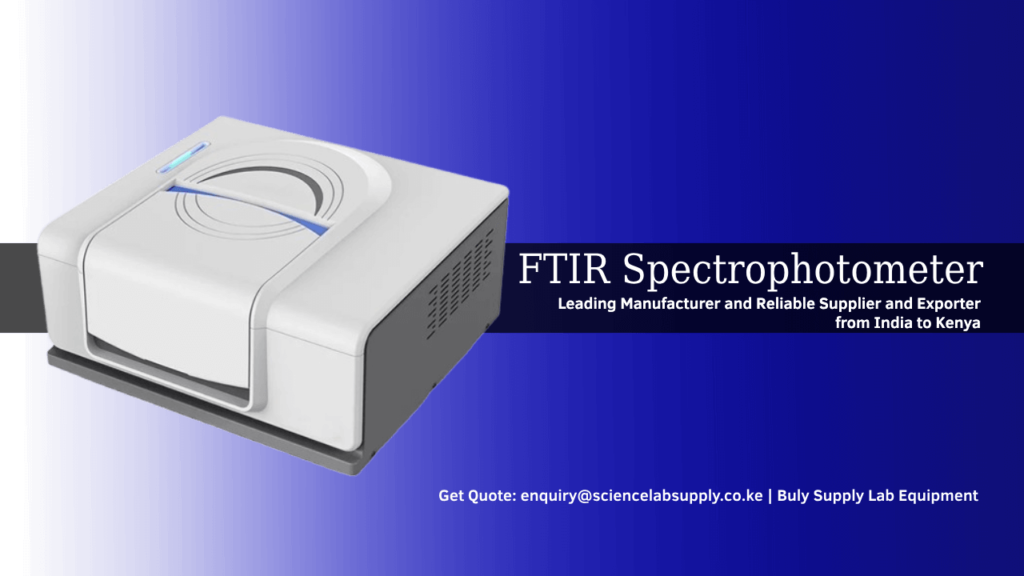
The essential equipment used by Educational Lab Equipment, the topmost FTIR Spectrophotometer Manufacturer & Exporter in Kenya, is the FTIR Spectrophotometer. The intended purpose of the spectrophotometer is to help in the identification and detailed analysis of the chemical content of a specific substance, and it is versatile enough to be used in the
general chemical analysis of samples in bulk.
An FTIR spectrometer comprises three main parts:
- The sample compartment is a specially designed chamber containing examined samples. It is typically sealed to avoid outside interference and purge water vapor for optimal results.
- Interferometer: Finally, its heart — an interferometer equipped with Michelson mirrors to separate infrared radiation into different frequencies — then combines these beams again for detection by its detector.
- Detector: The detector converts interference patterns into electrical signals that a computer records and processes to create a spectrum for each sample—just like chemical fingerprinting! These spectral records allow us to match every original sample exactly!
Latest Features With FTIR Spectrophotometer Supplier
FTIR (Fourier Transform Infrared) spectrophotometers are versatile tools with unique features and capabilities. Here is an overview:
Benchtop FTIR Spectrophotometers
- Typical wavelength range: 4000-400 cm⁻¹
- Resolution: 0.5-2 cm⁻¹
- Sensitivity: Can detect concentrations as low as parts per million (ppm)
- Sample types: Solids, liquids, and gases
Portable FTIR Spectrophotometers
- Typical wavelength range: 4000-400 cm⁻¹
- Resolution: 4-8 cm⁻¹
- Sensitivity: Can detect concentrations as low as parts per hundred (pph)
- Sample types: Solids and liquids
Mid-Infrared FTIR Spectrophotometers
- Typical wavelength range: 4000-400 cm⁻¹
- Resolution: 0.5-2 cm⁻¹
- Sensitivity: Can detect concentrations as low as parts per million (ppm)
- Sample types: Solids, liquids, and gases
Near-Infrared FTIR Spectrophotometers
- Typical wavelength range: 12800-4000 cm⁻¹
- Resolution: 2-8 cm⁻¹
- Sensitivity: Can detect concentrations as low as parts per hundred (pph)
- Sample types: Solids and liquids
Micro-FTIR Spectrophotometers
- Typical wavelength range: 4000-400 cm⁻¹
- Resolution: 0.5-2 cm⁻¹
- Sensitivity: Can detect concentrations as low as parts per million (ppm)
- Sample types: Small samples (e.g., fibers, particles)
Attenuated Total Reflectance (ATR) FTIR Spectrophotometers
- Typical wavelength range: 4000-400 cm⁻¹
- Resolution: 0.5-2 cm⁻¹
- Sensitivity: Can detect concentrations as low as parts per million (ppm)
- Sample types: Solids and liquids
Such spectrometers evaluate materials accurately and efficiently without any hassles. It makes the devices useful for applications like material analysis, environmental studies, and quality assurance.
FTIR Spectrophotometers and Their Applications
The pharmaceutical and food industries widely utilize FTIR spectrophotometers to measure trans fat levels in their products and as an essential tool in drug development.
Food and pharmaceutical industries aren’t the only fields where FTIR spectrophotometers can be found; these versatile instruments have also found use in manufacturing advanced composites, characterizing new material chemistry and properties, analyzing semiconductor wafer surfaces during fabrication of microelectronics, monitoring coating oxidation/degradation rates/paint degradation levels for microelectronic fabrication processes; investigating energy storage solutions such as lithium-ion batteries; etc.
FTIR instruments are engineered explicitly by the topmost FTIR spectrophotometer manufacturer to withstand harsh environmental conditions. Their robust construction allows them to work at temperatures from -40 to +200 degrees while remaining humidity levels between 0%-100 are tolerated without experiencing vibration or shocks. Furthermore, their essential mechanical parts, such as cuvettes – designed to shine light through fragile films of samples – are made of industrial diamond – making these instruments less vulnerable than glass in terms of wear resistance. As a result, many FTIR instruments run without calibration costs or need for calibration – providing great alternatives in remote locations or locations with limited resources.
To meet the varying demands of various applications, FTIR spectrophotometer manufacturers have designed an array of accessories that can enhance the performance of an FTIR system in multiple fields; one such accessory is an attenuated total reflection (ATR) which allows an analyzer to focus on surface properties rather than bulk properties of materials being tested, providing more accurate and faster measurements.