


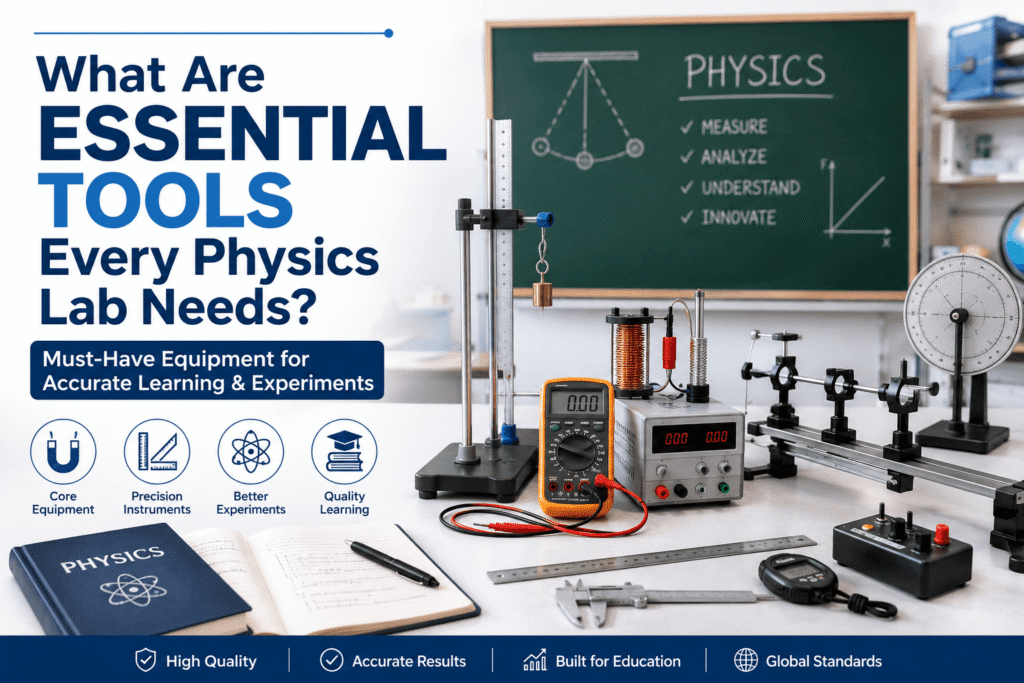
An efficient laboratory for physics provides students, teachers and technical professionals with all of the equipment they require for studying physical phenomena and fundamental scientific principles; taking measurements; validating theories with practical tests; measuring length and duration as well as studying electricity, magnetism optics mechanics sound and heat are just a few ways physics instruction is made more efficient, precise and enjoyable with proper laboratory equipment in the right places.
Selecting appropriate equipment for physics labs at colleges, schools and universities as well as technical colleges is of utmost importance – selecting basic instruments alongside special devices will enable students to safely conduct experiments while developing practical experience and skillsets.
This guide outlines the key equipment required by any lab in physics, such as measurement instruments, mechanical equipment electronic instruments optics apparatus thermal experiment equipment as well as laboratory safety equipment.
1. Measuring Instruments for Physics Experiments
Accurate measurement lies at the core of all physics research, so any laboratory performing such work needs an array of instruments capable of accurately measuring mass, length time and temperature as well as any other physical quantities that might arise in its studies.
Common measuring instruments include:
- Meter scales and measuring rulers
- Vernier calipers
- Screw gauges or micrometers
- Measuring cylinders
- Stopwatches
- Digital balances
- Thermometers
- Digital multimeters
- Measuring tapes
- Beam balances.
Measuring Instruments list like Vernier calipers can be invaluable tools in measuring external and internal dimensions of objects accurately, while screw gauges offer precise measurements of smaller dimensions and thicknesses.
Educational laboratories must equip their students with both traditional and modern measuring equipment in order to understand measurement methods, precision, the least count count figures important figures as well as experimental errors. This will enable students to better grasp measurement methodologies precision measures the least count number important figures as well experimental errors.
2. Mechanics Lab Equipment
Geology is one of the core disciplines in physics. It encompasses motion forces, work, momentum, energy as well as gravity and rotational movements.
An effective mechanics lab must contain equipment like:
- Newton’s law apparatus
- Inclined plane apparatus
- Pulley systems
- Sonometer
- Simple pendulum apparatus
- Compound pendulum
- Hooke’s law apparatus
- Spring balances
- Force tables
- Projectile motion apparatus
- Trolleys and tracks
- Collision apparatus
- Centripetal force apparatus
- Moment of inertia apparatus
Students can explore important concepts like friction, acceleration and gravitational acceleration as well as equilibrium, elasticity momentum and dynamic rotation.
Hooke’s Law apparatuses serve to demonstrate the relationship between force applied and lengthening of elastic materials, and lengthening. A pendulum apparatus provides another approach, showing us its relationship between length of pendulum swing and time span.
3. Optics Laboratory Equipment
Optics exercises help students develop an understanding of light’s behavior, including reflection, refraction and dispersion as well as interference, diffraction and polarization.
Essential optics lab equipment includes:
- Optical benches
- Convex and concave lenses
- Convex and concave mirrors
- Prisms
- Ray boxes
- Optical pins
- Lens holders
- Mirror holders
- Screen assemblies
- Diffraction gratings
- Spectrometers
- Polarimeters
- Light sources
- Laser sources
- Interference apparatus
An optical bench is especially useful because it allows multiple components to be positioned accurately along a common axis.
Students can use these instruments to perform experiments involving focal length, image formation, refractive index, prism deviation, wavelength measurement, diffraction, and polarization.
4. Electrical and Electronics Lab Equipment
Electricity and electronics form an important part of modern physics education. A physics laboratory should therefore contain appropriate instruments for studying current, voltage, resistance, circuits, electromagnetic effects, and basic electronic components.
Important electrical laboratory equipment includes:
- Digital multimeters
- Ammeter
- Voltmeter
- Galvanometer
- DC power supplies
- AC power supplies
- Resistance boxes
- Rheostats
- Potentiometers
- Decade resistance boxes
- Circuit boards
- Connecting wires
- Transformers
- Capacitors
- Inductors
- Diodes
- Transistors
- Oscilloscopes
- Function generators
A digital multimeter can be one of the most flexible tools in a physics education lab because it is able to test current, voltage and resistance.
An oscilloscope gives students a visual representation of electrical signals. It’s particularly helpful for studying waveform characteristics like frequency and amplitude as well as phases and transient signals.
5. Magnetism and Electromagnetism Equipment
Experiments on magnetic fields and electromagnetic induction require special-designed equipment to assist students in understanding the link between magnetism and electricity.
Essential equipment can include:
- Bar magnets
- Horseshoe magnets
- Magnetic compass sets
- Electromagnets
- Solenoids
- Galvanometers
- Magnetic field apparatus
- Electromagnetic induction kits
- Transformer demonstration kits
- Search coils
- Helmholtz coil apparatus
Students can utilize these tools to explore magnetic fields, the electromagnetic effect, Faraday’s Law Lenz’s law permeability as well as conductors carrying current in a magnetic field.
6. Heat and Thermodynamics Laboratory Equipment
Experiments on thermodynamics and heat require instruments for measuring temperatures, expansion rates, heat transfer properties as well as thermal properties.
Common equipment includes:
- Laboratory thermometers
- Digital thermometers
- Calorimeters
- Specific heat apparatus
- Thermal conductivity apparatus
- Linear expansion apparatus
- Steam generators
- Heat transfer demonstration equipment
- Thermal radiation apparatus
- Joule’s calorimeter
Calorimeters can be invaluable tools when conducting experiments involving heat generation or exchange.
Thermal expansion equipment provides an understanding of how solids’ sizes change as temperature varies and provides concrete illustrations of thermal expansion principles.
An optimally equipped physics laboratory must give students an opportunity to integrate theoretical ideas with real-life experiments, from measuring instruments and mechanics equipment through electricity, optics, thermodynamics, magnetism and modern physics equipment – each area contributing towards creating an enjoyable learning environment in science.
Selecting reliable equipment for physics labs in schools, universities, technical institutes and government educational initiatives is an important investment towards practical science education. A well-planned lab should include precise instruments, sturdy equipment with safety precautions in mind as well as digital technology compatible with their curriculum and safety precautions for an immersive science experience.
Institutions should carefully evaluate all equipment purchased for laboratory use to ensure its quality, accuracy, longevity and safety as well as curriculum compatibility technical support and replacement part availability. Partnering with an established laboratory equipment supplier or manufacturer makes choosing equipment easier as well as setting it up quickly with long term support available from experienced vendors and manufacturers.
An effectively equipped physics lab offers students more than access to instruments; it creates an atmosphere conducive to taking measurements, observing experiments and testing outcomes, understanding scientific concepts and developing real-life problem-solving abilities.